

When War Makes Headlines: What History Tells Us About Markets and Uncertainty
Before we talk about markets or money, it’s important to acknowledge something first.
Right now, thousands of service members are involved in military operations across the Middle East. Some families have loved ones deployed in the region. For them, this isn’t just a geopolitical headline—it’s deeply personal.
Even for those without direct connections, the pace and intensity of global news can be unsettling. Images of conflict, reports of retaliation, and speculation about what might come next can create a sense that the world is suddenly less stable.
Moments like these remind us that people matter far more than portfolios.
But it’s also natural for investors to ask a practical question when events like this unfold:
What does this mean for markets and the economy?
Recent events have heightened those concerns. Military strikes by the United States and Israel targeting Iran’s leadership, military assets, and nuclear infrastructure have escalated tensions across the region. Iran has responded with missile and drone attacks, and the situation continues to evolve.
No one knows exactly how this conflict will develop. But history offers important perspective on how financial markets tend to respond to geopolitical events—and what long-term investors should keep in mind.
Geopolitical conflict is nothing new for markets
War and geopolitical tension are tragic realities that have appeared throughout modern financial history. Over the past century, markets have faced World War II, the Korean War, the Vietnam War, the Gulf War, the wars in Iraq and Afghanistan, terrorist attacks, regional conflicts, and countless political crises.
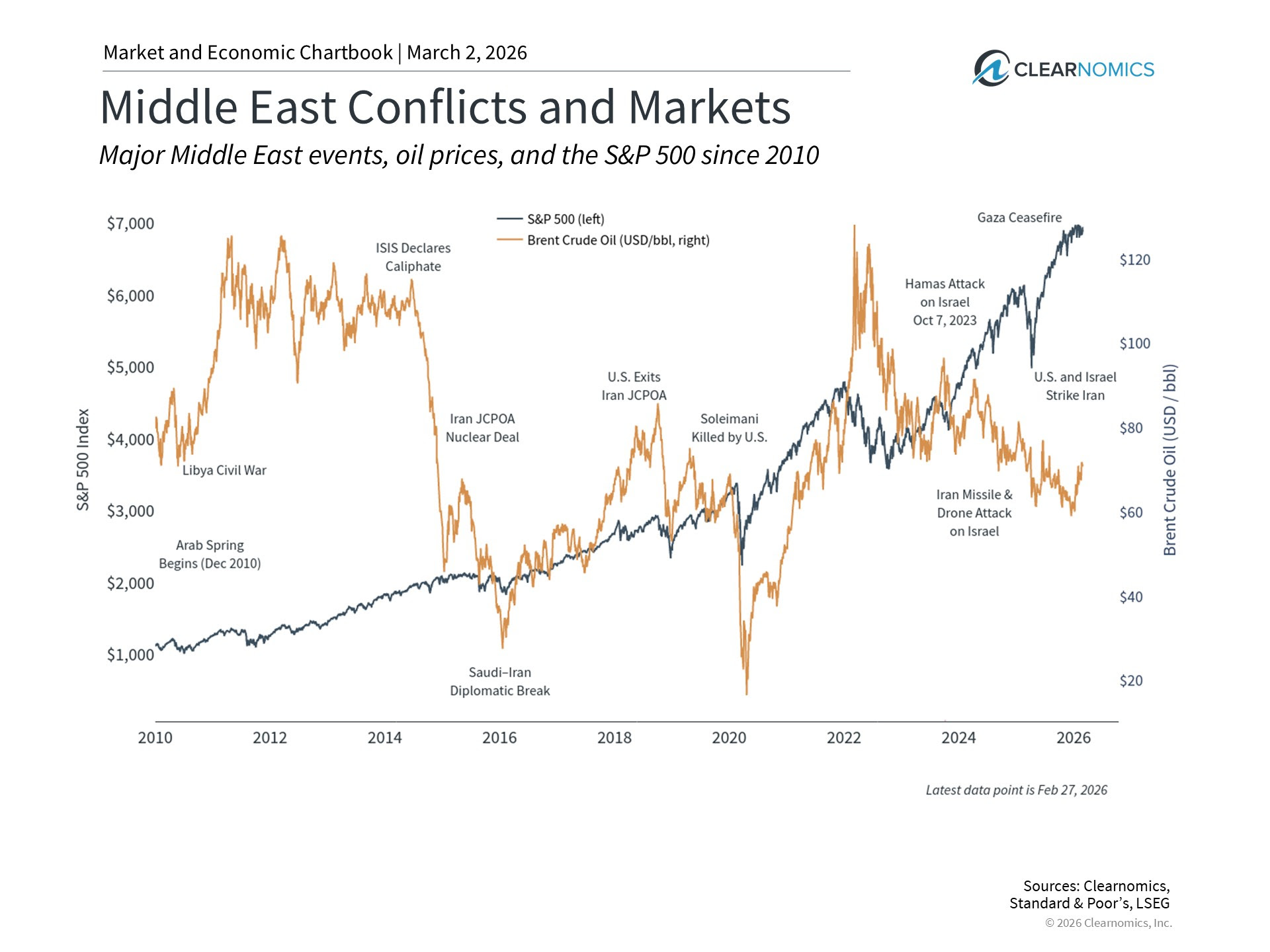
More recently, investors have watched markets navigate the Russia–Ukraine war, the Israel–Hamas conflict, and other periods of international tension.
While each event is unique, a consistent pattern emerges: markets often react quickly to uncertainty, but longer-term performance tends to be driven by economic fundamentals rather than geopolitical headlines.
This doesn’t mean markets ignore global events. Initial reactions can be sharp. But over time, investors typically shift their focus back to corporate earnings, economic growth, interest rates, and innovation.
As President Dwight D. Eisenhower once said:
Plans are worthless, but planning is everything.
The specific crisis may change, but the need for preparation does not. Long-term financial planning exists precisely because uncertainty is unavoidable.
Why energy markets often react first
One of the most direct ways conflicts in the Middle East affect financial markets is through energy prices.
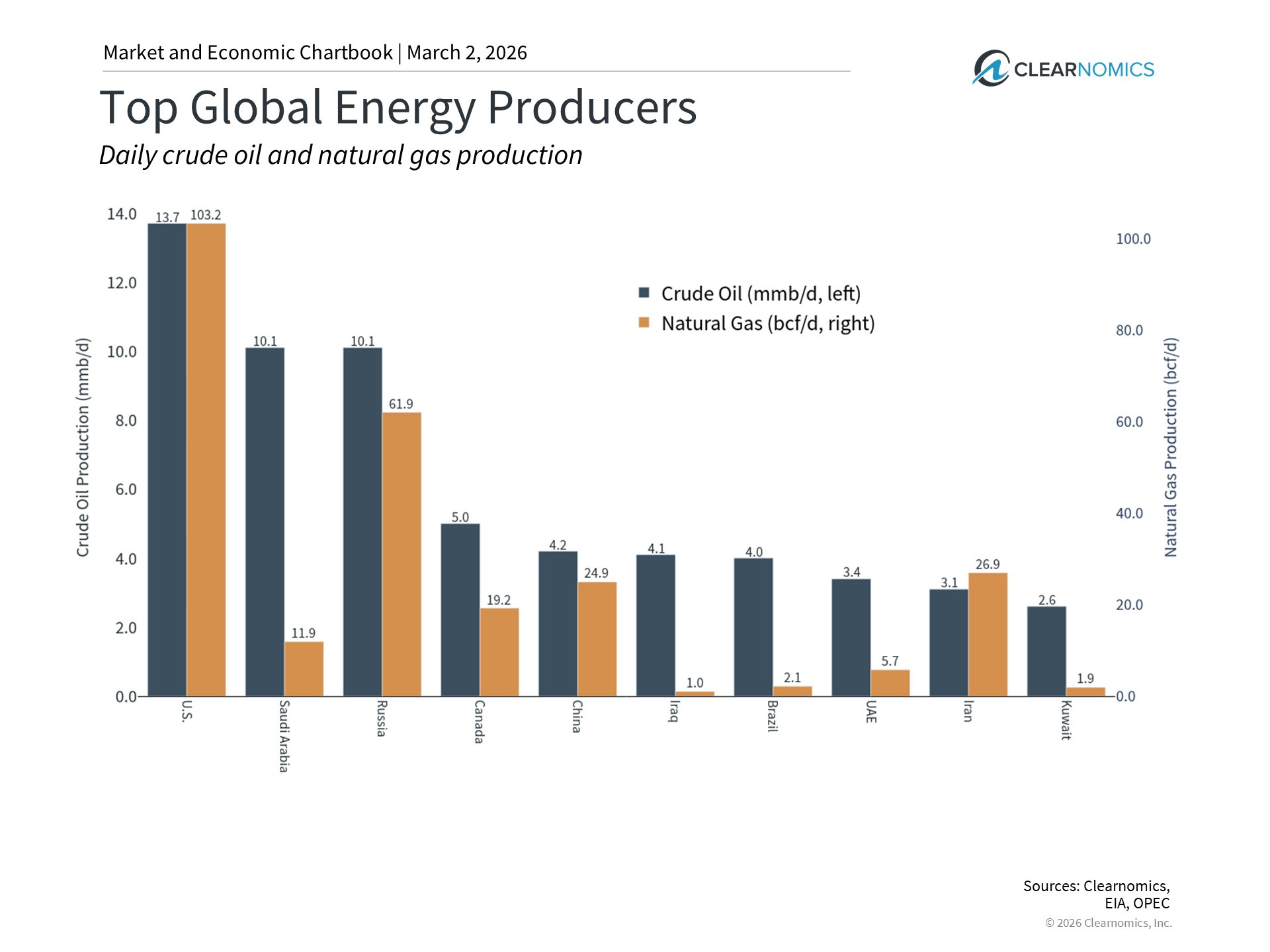
Iran is a major energy producer, generating roughly 3 million barrels of oil per day along with substantial natural gas production. The country also sits along the Strait of Hormuz, one of the world’s most important shipping routes for energy.
A significant portion of global oil and natural gas exports travels through this narrow waterway. Even the possibility of disruption can push energy prices higher.
When tensions escalate, traders often react immediately. Oil prices may rise, stock markets may pull back, and safe-haven assets like gold can gain attention.
This type of reaction is common because energy touches nearly every part of the economy. Higher fuel prices can affect transportation costs, corporate margins, and household budgets.
However, context matters.
Oil prices today remain well below the levels seen in 2022 following Russia’s invasion of Ukraine. In addition, the global energy landscape has changed significantly in recent years. The United States is now the world’s largest producer of oil and natural gas, which provides some insulation from global supply disruptions.
And importantly, energy markets have a long history of reacting quickly—and then stabilizing faster than expected.
Markets tend to adjust as uncertainty becomes clearer
Financial markets behave a bit like a smoke alarm.
When potential danger appears, they react immediately—even before all the facts are known.
That’s why geopolitical events often cause sudden market volatility in the early stages of a conflict. Investors adjust prices quickly to reflect possible risks: disruptions to energy supplies, inflation pressures, or economic uncertainty.
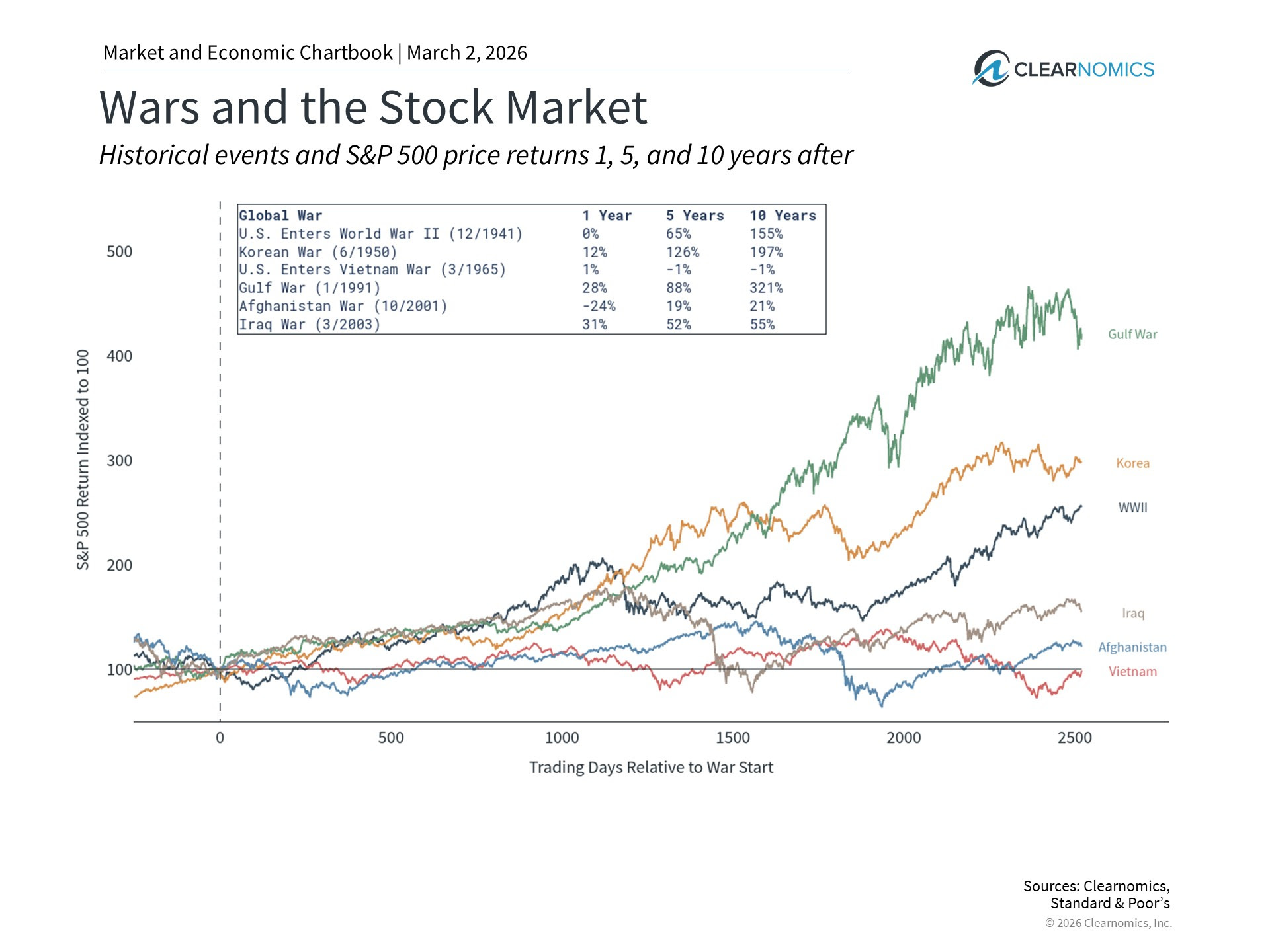
But as more information becomes available, markets typically recalibrate.
Sometimes tensions escalate further. Other times conflicts stabilize or move into prolonged negotiations. Markets adjust along the way as probabilities change.
This process can feel chaotic in the moment, especially when headlines are intense. But volatility during global events is not unusual—it’s part of how markets process uncertainty.
The long-term lesson for investors
If history teaches us anything about investing during geopolitical crises, it’s this:
Reacting emotionally to headlines has rarely been a successful investment strategy.
Markets have weathered wars, recessions, energy shocks, political upheaval, and even global pandemics. Over the long run, they have continued to grow alongside economic progress, technological innovation, and population growth.
That doesn’t mean short-term declines never happen. They do. But trying to predict exactly when to move in and out of markets during periods of uncertainty is extraordinarily difficult.
In fact, missing just a handful of the market’s strongest recovery days can significantly reduce long-term returns.
That’s why a thoughtful financial plan assumes volatility will occur. Diversification, time horizon alignment, and disciplined decision-making are designed specifically to navigate periods like this.
In other words, uncertainty isn’t a flaw in the system.
It’s part of the system.
Perspective matters during uncertain times
Moments like these can make the world feel unpredictable. And in many ways, it is.
But uncertainty has always been part of investing—and part of life.
While the headlines may evolve in the coming days and weeks, most long-term financial goals remain the same: building security, supporting family, and creating the freedom to live according to your values.
For investors, maintaining perspective during uncertain times can often be the most valuable strategy of all.
And if you ever want to talk through what’s happening—or simply ask questions—I’m always here to take your call.
